
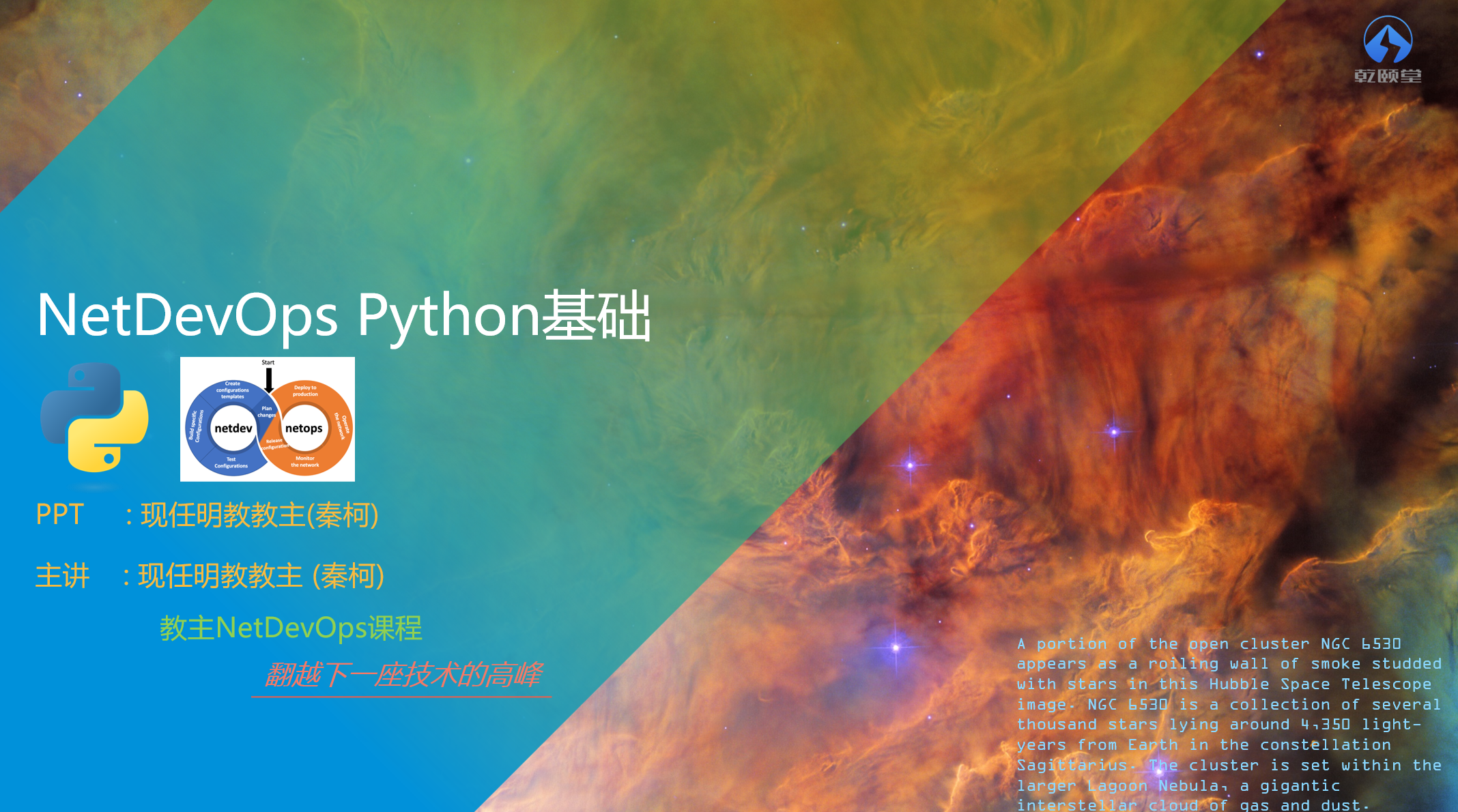
Course Introduction
Designed for network engineers and automation practitioners, this course builds a complete Python foundation through network-operations scenarios. It covers the development environment, numbers and strings, regular expressions, lists, dictionaries, tuples, files, control flow, functions, modules, classes, common built-in modules, data persistence, multithreading, multiprocessing, coroutines, and exception handling. Hands-on code includes network data processing, SSH, databases, XML, JSON, and Jinja2, preparing learners for classic automation protocols, NetDevOps, and AIOps.
Companion Git repository: https://git.qytang.com/qytadmin/python_basic
CURRICULUM
Course Curriculum
17
-
01
- 1.1
Python History, Ecosystem, and Use Cases
- 1.2
Python Features and Version Differences
- 1.1
-
02
- 2.1
Installing Python and pip on Windows
- 2.2
Installing Python and pip on Linux
- 2.3
Development Tools, Interpreters, and Documentation
- 2.1
-
03
- 3.1
Integers, Floats, Complex Numbers, and Booleans
- 3.2
Numeric Operations, Comparisons, and Math Utilities
- 3.1
-
04
- 4.1
String Creation, Indexing, Slicing, and Immutability
- 4.2
String Methods, Formatting, and Encoding
- 4.3
Regular Expression Syntax and Matching
- 4.4
Regular Expressions for Network Text Processing
- 4.1
-
05
- 5.1
List Creation, Indexing, Slicing, and Methods
- 5.2
List Comprehensions, Sorting, and Nested Structures
- 5.3
Dictionary Keys, Values, Methods, and Iteration
- 5.4
Nested Dictionaries, Sorting, and Network Data Modeling
- 5.1
-
06
- 6.1
Tuple Immutability, Packing, and Unpacking
- 6.2
Opening, Reading, Writing, and Closing Files
- 6.3
with Context Management and File Pointers
- 6.4
Text, CSV, and Network Configuration File Processing
- 6.1
-
07
- 7.1
Variables, Object References, and Multiple Assignment
- 7.2
Sequence Unpacking, Extended Unpacking, and Augmented Assignment
- 7.1
-
08
- 8.1
print Arguments, Separators, and Endings
- 8.2
String Formatting and Output Redirection
- 8.1
-
09
- 9.1
Truth Values, Comparisons, and Boolean Logic
- 9.2
if, elif, else, and Conditional Expressions
- 9.1
-
10
- 10.1
while Loops and Loop Control
- 10.2
for, range, and Sequence Iteration
- 10.3
break, continue, and Loop else
- 10.4
enumerate, zip, and Comprehensions
- 10.1
-
11
- 11.1
Function Definition, Calls, and Return Values
- 11.2
Positional, Keyword, Default, and Variadic Arguments
- 11.3
Scope, LEGB, global, and nonlocal
- 11.4
lambda, Recursion, and Functional Tools
- 11.1
-
12
- 12.1
import, from, as, and Module Search Paths
- 12.2
__name__, Module Testing, and Package Structure
- 12.3
Third-Party Modules, pip, and Virtual Environments
- 12.1
-
13
- 13.1
Classes, Objects, Attributes, and Methods
- 13.2
Inheritance, Method Overriding, and Polymorphism
- 13.3
Encapsulation, Properties, and Class Methods
- 13.4
Special Methods and Object-Oriented Practice
- 13.1
-
14
- 14.1
sys: Interpreter and Runtime Environment
- 14.2
os: Filesystem and Operating System Interfaces
- 14.3
datetime: Date and Time Processing
- 14.4
argparse: Command-Line Argument Parsing
- 14.1
-
15
- 15.1
Object Serialization with pickle
- 15.2
Key-Value Persistence with shelve
- 15.3
Databases and Python Data Access
- 15.4
Parsing and Generating XML
- 15.5
JSON Data Processing
- 15.6
Comparing and Selecting Data Formats
- 15.1
-
16
- 16.1
Thread Creation, Concurrency, and Synchronization
- 16.2
Locks, Queues, and Thread Pools
- 16.3
Processes, Process Pools, and IPC
- 16.4
Concurrency Models in Network Automation
- 16.1
-
17
- 17.1
try, except, else, and finally
- 17.2
raise, assert, and Custom Exceptions
- 17.3
Exception Debugging and Robust Script Design
- 17.1
COURSE RECORDINGS
Course Video
Watch the public preview here or open it on the original video platform.
BILIBILI01
PUBLIC PREVIEW
NetDevOps Python Foundations 0: Internal System Introduction
33 MIN
Watch on the Original PlatformBILIBILI02
PUBLIC PREVIEW
NetDevOps Python Foundations 1: Introduction to Python
64 MIN
Watch on the Original PlatformBILIBILI03
BILIBILI04
BILIBILI05
PUBLIC PREVIEW
NetDevOps and AIOps Python Foundations: Assignment Introduction
15 MIN
Watch on the Original Platform